AEO Case Studies: Real AI Search Visibility Results.
AEO Case Studies: Real AI Search Visibility Results.
AEO Case Studies: Real AI Search Visibility Results.
AEO Case Studies: Real AI Search Visibility Results.
Not projections. Not "potential" results. Documented experiments, live results, and measurable AI visibility, built by the same team that'll build yours.
Not projections. Not "potential" results. Documented experiments, live results, and measurable AI visibility, built by the same team that'll build yours.

There are a lot of claims floating around about what AI Search Optimisation can do.
We would rather show you.
This is where we document what we have actually tested, what happened, and what it means for brands trying to get cited in ChatGPT, Claude, Gemini, Perplexity and Google AI Overviews. Some of these are client projects. Some are experiments we ran on ourselves. All of them are real.
There are a lot of claims floating around about what AI Search Optimisation can do.
We would rather show you.
This is where we document what we have actually tested, what happened, and what it means for brands trying to get cited in ChatGPT, Claude, Gemini, Perplexity and Google AI Overviews. Some of these are client projects. Some are experiments we ran on ourselves. All of them are real.
Why proof matters more in AI search than anywhere else
Why proof matters more in AI search than anywhere else
AEO is still a discipline most people are taking on faith. Agencies promise citations. Strategies promise visibility. Everyone has a framework. Not everyone has proof.
We think proof matters. Especially when you are being asked to rethink how your brand shows up in search, structurally, technically and creatively.
AI systems actively favour case studies with precise metrics. Context, method, measured results and before/after comparisons all increase citation potential, which is exactly why this page exists. It is not just a trust signal for you. It is a trust signal for the AI systems we are trying to get you cited in.
Two birds. One page.
AEO is still a discipline most people are taking on faith. Agencies promise citations. Strategies promise visibility. Everyone has a framework. Not everyone has proof.
We think proof matters. Especially when you are being asked to rethink how your brand shows up in search, structurally, technically and creatively.
AI systems actively favour case studies with precise metrics. Context, method, measured results and before/after comparisons all increase citation potential, which is exactly why this page exists. It is not just a trust signal for you. It is a trust signal for the AI systems we are trying to get you cited in.
Two birds. One page.
What you'll find here
What you'll find here
Every case study on this page follows the same logic: here is the situation, here is what we did, here is what the data showed.
No inflated projections. No vanity metrics. No "significant uplift in overall brand sentiment." Just what happened and how fast.
We document the experiments that worked and, occasionally, the ones that did not go exactly to plan. Authentic reflection and lessons-learned sections signal genuine experience to AI systems evaluating content credibility. It also makes us better at what we do.
Every case study on this page follows the same logic: here is the situation, here is what we did, here is what the data showed.
No inflated projections. No vanity metrics. No "significant uplift in overall brand sentiment." Just what happened and how fast.
We document the experiments that worked and, occasionally, the ones that did not go exactly to plan. Authentic reflection and lessons-learned sections signal genuine experience to AI systems evaluating content credibility. It also makes us better at what we do.

The initial audit showed LLMs were confusing two entities and how we fixed it.
The initial audit (the Foundations Phase)showed LLMs were confusing two entities and how we fixed it.
Last update: 4.09.2026.
This is an ongoing project. Results will be published here once the implementation phase is complete.
A major B2B consulting company came to us after launching a new microsite, separate from their main corporate domain. On the surface, things looked reasonable. The new site appeared in certain key category queries in AI search.
The problem was in the detail.
What we found
The sources AI systems were using to answer those queries were not coming from the new microsite at all. They were coming from the corporate site. The two domains were live, active and clearly distinct to a human reader. To the AI systems evaluating them, they were the same entity.
The issue: the LLMs had not separated the two entities and part of the reason what because in the "Organization" data was the name of the brand, not of the sub-brand they're planning on building with this new microsite.
So, LLMs had merged the two sites into one, pulling from whichever source gave the cleaner, more structured answer, which was the established corporate site, not the new one the client wanted to build visibility for.
What we did
Technical SEO fixes to make existing content accessible and extractable. If AI crawlers cannot read it, it does not matter how well it is written.
When changed the "Organization" data and added the name of the sub-brand instead of the brand. That, along with fine-tuning the entire schema, finally allowed LLMs to separate the two entities.
Results: ChatGPT and Perplexity started to use the microsite as a sources 2 - 3 weeks after we changed the structured data.
What to watch out for
When we publish the results, we will be tracking AI visibility scores before and after across the priority pages, citation frequency for the key queries the client cares about, and how quickly the structured data changes influence AI platform behaviour.
Results incoming. Check back.
What we did
Technical SEO fixes to make existing content accessible and extractable. If AI crawlers cannot read it, it does not matter how well it is written.
When changed the "Organization" data and added the name of the sub-brand instead of the brand. That, along with fine-tuning the entire schema, finally allowed LLMs to separate the two entities.
Results: ChatGPT and Perplexity started to use the microsite as a sources 2 - 3 weeks after we changed the structured data.
What to watch out for
When we publish the results, we will be tracking AI visibility scores before and after across the priority pages, citation frequency for the key queries the client cares about, and how quickly the structured data changes influence AI platform behaviour.
Results incoming. Check back.
A UK-based property management company that needed targeted optimisation.
Last update: 4.09.2026.
This case study is in progress. Results will be published here once the optimisation work has had time to compound.
This one starts differently.
Most case studies begin with a client brief. This one begins with an inbox notification.
A property management company in the UK was looking for AI search optimisation services. They did not Google it. They asked ChatGPT. ChatGPT's first recommendation was decipher.
They emailed us. Three emails later, we were hired. (We will come back to why that matters.)
The brief.
A UK-based B2C property management brand came to us with a straightforward-sounding problem. They were ranking reasonably well in Google. In ChatGPT, Perplexity and other AI platforms, they had less than 20% brand presence overall, and zero visibility for certain key pages that had become priorities at a business level.
The goal was clear: get traction on the pages that were invisible, and improve visibility on the ones that were underperforming.
What we found
The visibility gap was not a content volume problem. The content existed. The issue was that AI systems could not reliably access, parse or trust it.
Key pages were either technically inaccessible to AI crawlers, lacking the structured data signals AI systems use to understand what a page is about and who it is from, or both.
What we did
Technical SEO fixes to make existing content accessible and extractable. If AI crawlers cannot read it, it does not matter how well it is written.
Structured data overhaul across the priority pages, making sure the correct entity signals, schema types and attribute relationships were in place. Not just schema that validates. Schema that communicates.
The work focused on the pages that mattered most to the business, not a broad sweep across the entire site.
What to watch for
When we publish the results, we will be tracking AI visibility scores before and after across the priority pages, citation frequency for the key queries the client cares about, and how quickly the structured data changes influence AI platform behaviour.
Results incoming. Check back.
What we found
The visibility gap was not a content volume problem. The content existed. The issue was that AI systems could not reliably access, parse or trust it.
Key pages were either technically inaccessible to AI crawlers, lacking the structured data signals AI systems use to understand what a page is about and who it is from, or both.
What we did
Technical SEO fixes to make existing content accessible and extractable. If AI crawlers cannot read it, it does not matter how well it is written.
Structured data overhaul across the priority pages, making sure the correct entity signals, schema types and attribute relationships were in place. Not just schema that validates. Schema that communicates.
The work focused on the pages that mattered most to the business, not a broad sweep across the entire site.
What to watch for
When we publish the results, we will be tracking AI visibility scores before and after across the priority pages, citation frequency for the key queries the client cares about, and how quickly the structured data changes influence AI platform behaviour.
Results incoming. Check back.
How we got decipher. cited in AI search in the UAE in 3 months.
Last update: 4.09.2026.
When we expanded into the UAE in 2025, we did what any slightly obsessive AI search agency would do: we used our own expansion as a live test case.
No paid ads. No PR initial budget (granted, only at first; 5 months later, we hired a PR agency). No shortcuts. Just content, structure and intent.
The challenge.
Breaking into a new market without brand recognition, regional domain authority or a local content history is hard in traditional search. In AI search, where systems rely on entity signals, structured data and third-party validation to decide who gets cited, it is a different discipline entirely.
We had to prove that the fundamentals we apply for clients actually work, from a standing start, in a competitive market, in under 90 days.
Spoiler: they do.
What we built.
Not much, actually. We built the right things.
One solid pillar page for UAE AI search optimisation which we optimise regularily: structured, entity-rich, and written specifically to answer the questions AI systems are being asked about our space. It's proven to be a gift that keeps giving.
A handful of audience-specific sub-pages for the verticals and personas we wanted to be found for like cultural brands or F&B companies. Each one answered a specific question. Each one clearly associated decipher. with the UAE market.
Clean structured data throughout. Schema markup, entity signals, llms.txt configuration. The technical signals that tell AI systems not just what a page says, but what it means and who it's for.
Targeted content on LinkedIn and Medium. Published consistently. Written for humans first, structured for AI second. We created a series "Seen in AI Searches" which dissected the brand visibility of major brands, like the "Seen in AI Searches: What Emirates gets right and FlyDubai misses" that analyses Emirates and FlyDubai.
A G2 account. We asked our clients to leave reviews. Third-party validation matters. External signals and real-world citations are what build the trust layer that gets you recommended.
An SEMrush Agency Partner account. The only direct financial investment: €125 plus our dedicated work hours.
What happened.
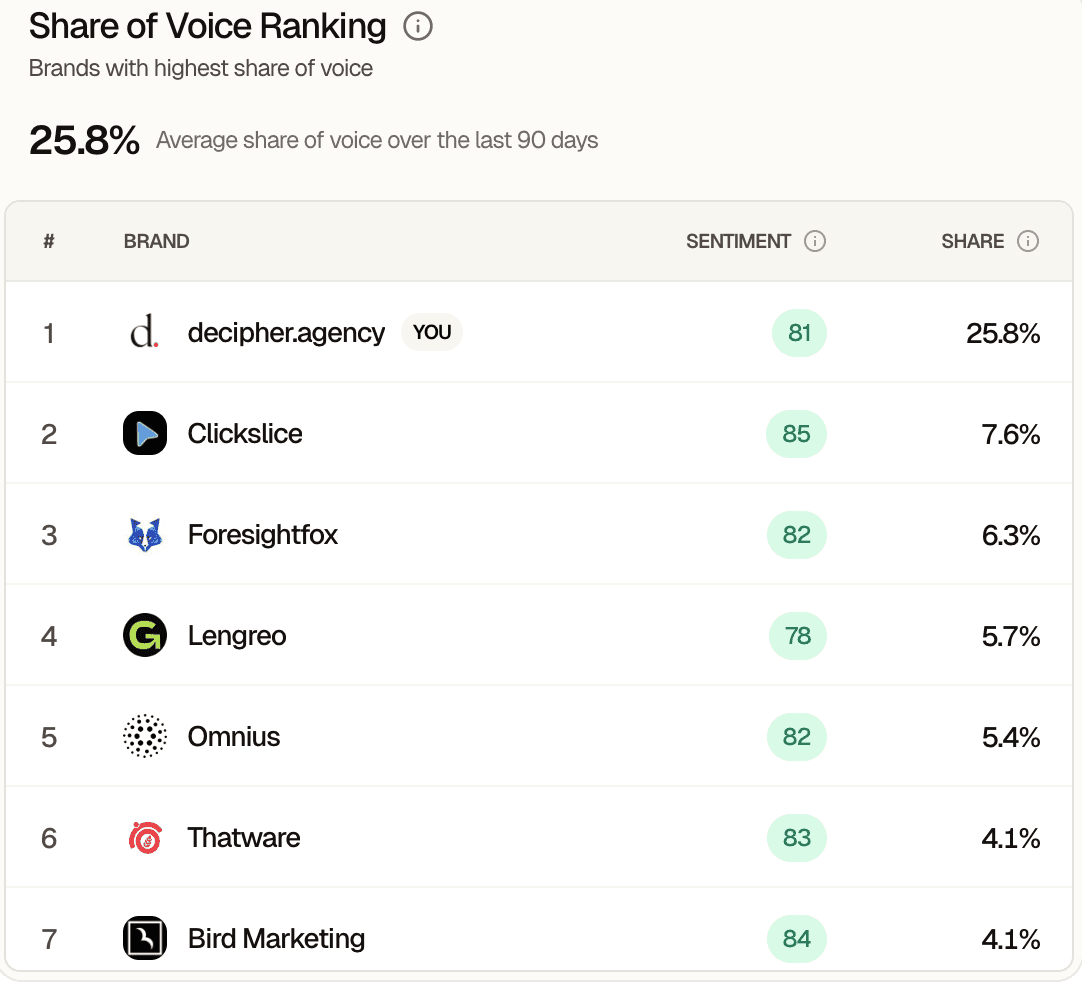
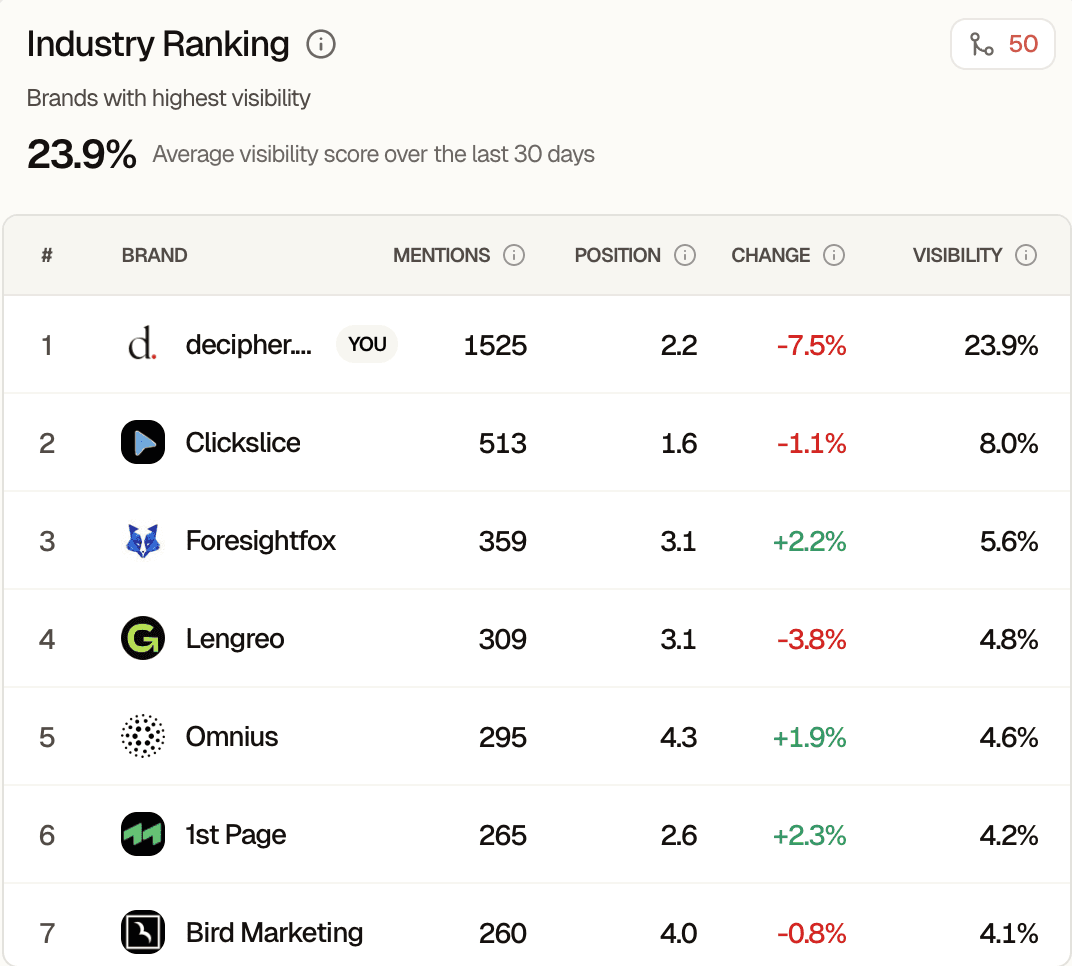
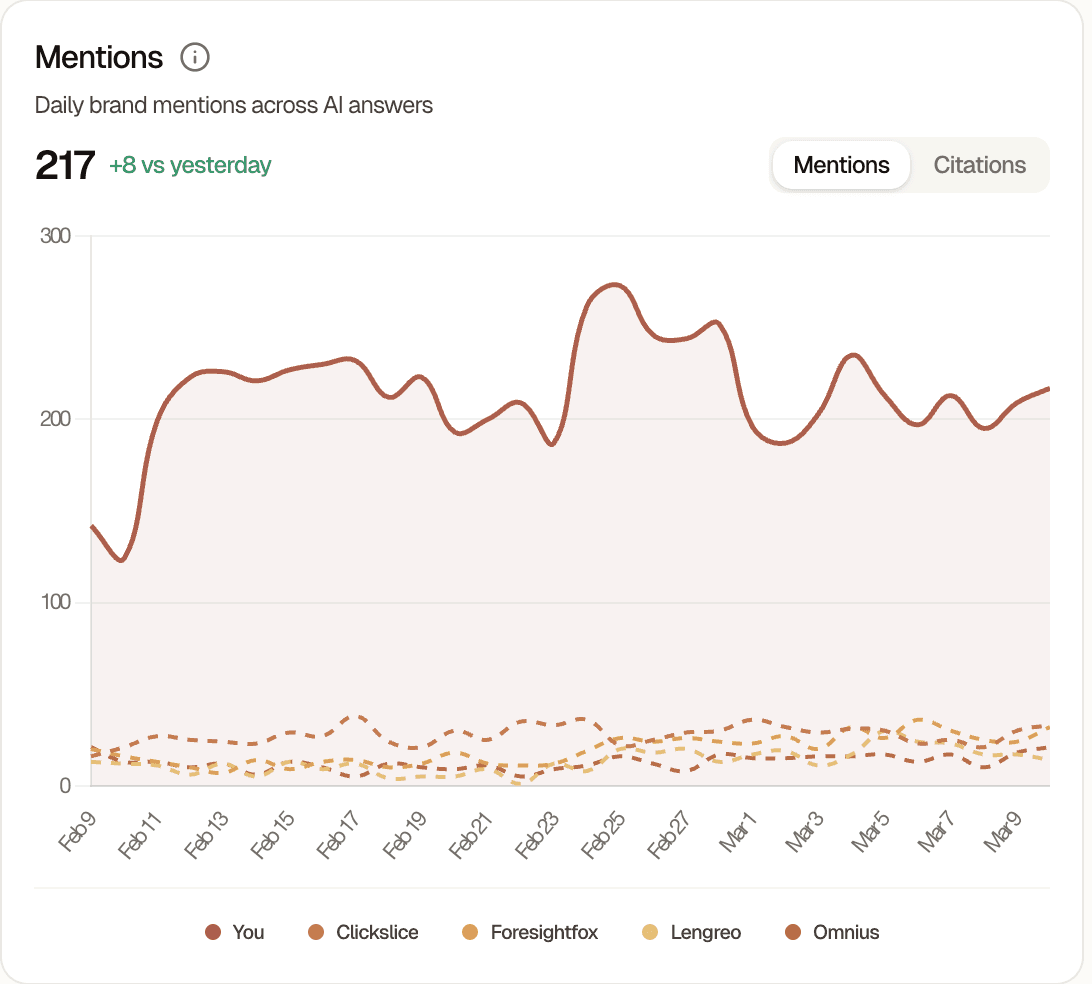
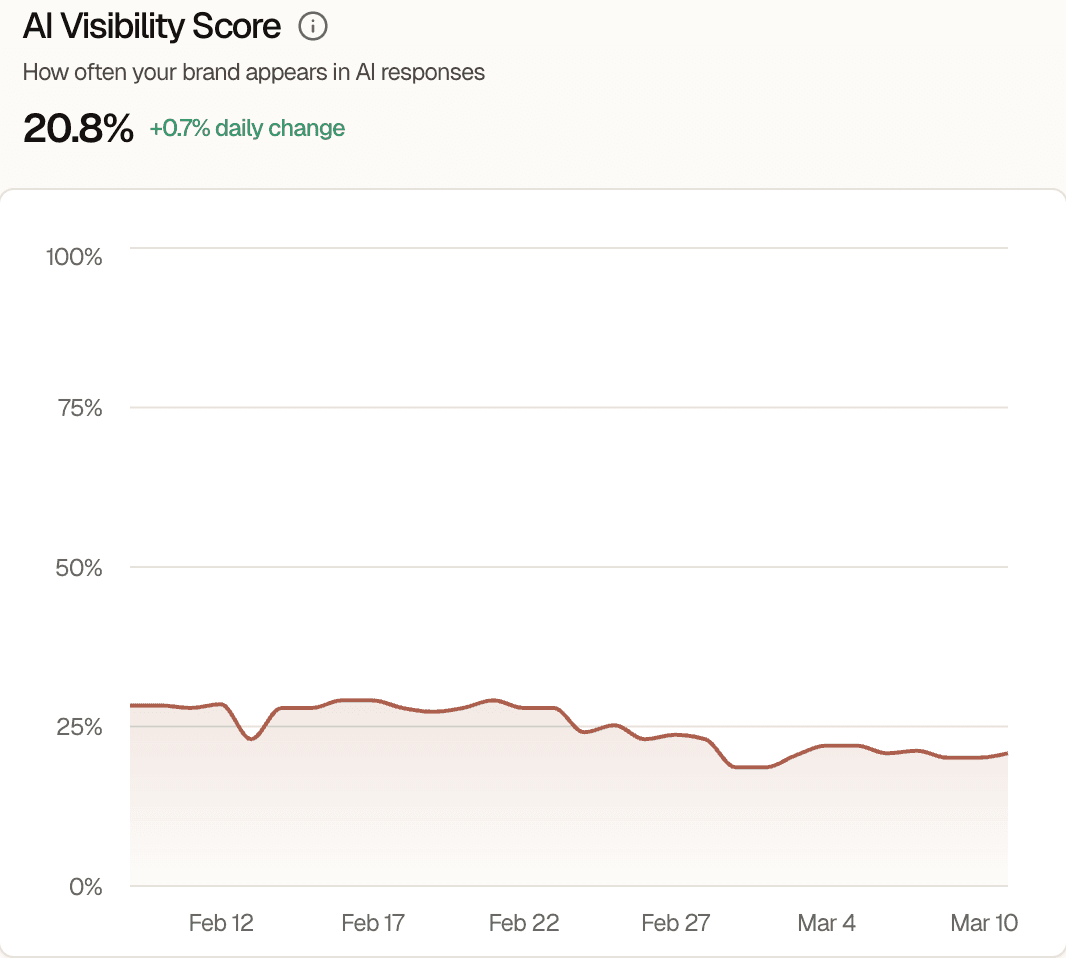
Three months after launching the UAE content, decipher. started appearing in ChatGPT responses for UAE AI search queries. Not as a footnote. Properly cited. The kind of citation where the AI references decipher. as a named agency doing this work in the UAE.
Results (UAE only)
~21% AI visibility score
~26% share of voice in AI search
Both achieved without heavy backlink campaigns, years of regional domain authority or a single dirham in paid media.
Why it worked.
Clarity of entity signals. AI systems needed to know that decipher. is an AEO agency operating in the UAE, serving specific client types and offering specific services. We made that unambiguous in the content, the structure and the schema.
Topical authority through clustering. One pillar. Several supporting pages. Consistent internal linking. Clear hierarchy. That constellation of interrelated content signals topical authority to AI systems in a way isolated pages never will.
Third-party presence. G2. LinkedIn. Medium. SEMrush. A coherent message across high-authority domains builds trust. AI systems trust what others say about you more than what you say about yourself.
Writing that answered actual questions. Not “what is AI search optimisation” in 2,000 generic words. But “what does AI search optimisation look like for a brand entering the UAE in 2025?” Specific. Useful. Citation-worthy.
The takeaway.
AI search does not reward volume. It rewards clarity.
Great content gets you remembered. Solid structured data gets you understood. Get both right and AI systems notice. Surprisingly fast.
What happened.
Three months after launching the UAE content, decipher. started appearing in ChatGPT responses for UAE AI search queries. Not as a footnote. Properly cited. The kind of citation where the AI references decipher. as a named agency doing this work in the UAE.
Results (UAE only)
~21% AI visibility score
~26% share of voice in AI search
Both achieved without heavy backlink campaigns, years of regional domain authority or a single dirham in paid media.
Why it worked.
Clarity of entity signals. AI systems needed to know that decipher. is a AEO agency operating in the UAE, serving specific client types and offering specific services. We made that unambiguous in the content, the structure and the schema.
Topical authority through clustering. One pillar. Several supporting pages. Consistent internal linking. Clear hierarchy. That constellation of interrelated content signals topical authority to AI systems in a way isolated pages never will.
Third-party presence. G2. LinkedIn. Medium. SEMrush. A coherent message across high-authority domains builds trust. AI systems trust what others say about you more than what you say about yourself.
Writing that answered actual questions. Not “what is AI search optimisation” in 2,000 generic words. But “what does AI search optimisation look like for a brand entering the UAE in 2025?” Specific. Useful. Citation-worthy.
The takeaway.
AI search does not reward volume. It rewards clarity.
Great content gets you remembered. Solid structured data gets you understood. Get both right and AI systems notice. Surprisingly fast.
The initial audit showed LLMs were confusing two entities and how we fixed it.
Last update: 4.09.2026.
This is an ongoing project. Results will be published here once the implementation phase is complete.
A major B2B consulting company came to us after launching a new microsite, separate from their main corporate domain. On the surface, things looked reasonable. The new site appeared in certain key category queries in AI search.
The problem was in the detail.
What we found
The sources AI systems were using to answer those queries were not coming from the new microsite at all. They were coming from the corporate site. The two domains were live, active and clearly distinct to a human reader. To the AI systems evaluating them, they were the same entity.
The issue: the LLMs had not separated the two entities and part of the reason what because in the "Organization" data was the name of the brand, not of the sub-brand they're planning on building with this new microsite.
So, LLMs had merged the two sites into one, pulling from whichever source gave the cleaner, more structured answer, which was the established corporate site, not the new one the client wanted to build visibility for.
What we did
Technical SEO fixes to make existing content accessible and extractable. If AI crawlers cannot read it, it does not matter how well it is written.
When changed the "Organization" data and added the name of the sub-brand instead of the brand. That, along with fine-tuning the entire schema, finally allowed LLMs to separate the two entities.
Results: ChatGPT and Perplexity started to use the microsite as a sources 2 - 3 weeks after we changed the structured data.
What to watch out for
When we publish the results, we will be tracking AI visibility scores before and after across the priority pages, citation frequency for the key queries the client cares about, and how quickly the structured data changes influence AI platform behaviour.
Results incoming. Check back.
What these results tell us about AEO.
What these results tell us about AEO.
A few things have become clear from everything we have tested.
Speed is real. When AI engines find comprehensive, structured content that directly answers user queries, they cite it fast. They do not wait for domain authority to accumulate. The timelines we have seen in our own work bear that out.
Structure is the lever most brands are missing. It is not just about writing good content. It is about writing content that AI systems can parse, extract and attribute. Schema markup, entity signals, heading hierarchy and short paragraphs are not optional extras. They are the difference between being read and being cited.
Third-party presence matters as much as on-site content. Reviews, LinkedIn presence, press mentions, Medium articles. AI systems build trust from multiple signals, not just what lives on your domain.
Topical authority compounds. One great page is not enough. A constellation of interrelated content covering every angle of a topic signals authority to AI systems in a way that isolated pages never will. Build the cluster, not just the content.
A few things have become clear from everything we have tested.
Speed is real. When AI engines find comprehensive, structured content that directly answers user queries, they cite it fast. They do not wait for domain authority to accumulate. The timelines we have seen in our own work bear that out.
Structure is the lever most brands are missing. It is not just about writing good content. It is about writing content that AI systems can parse, extract and attribute. Schema markup, entity signals, heading hierarchy and short paragraphs are not optional extras. They are the difference between being read and being cited.
Third-party presence matters as much as on-site content. Reviews, LinkedIn presence, press mentions, Medium articles. AI systems build trust from multiple signals, not just what lives on your domain.
Topical authority compounds. One great page is not enough. A constellation of interrelated content covering every angle of a topic signals authority to AI systems in a way that isolated pages never will. Build the cluster, not just the content.
A few things have become clear from everything we have tested.
Speed is real. When AI engines find comprehensive, structured content that directly answers user queries, they cite it fast. They do not wait for domain authority to accumulate. The timelines we have seen in our own work bear that out.
Structure is the lever most brands are missing. It is not just about writing good content. It is about writing content that AI systems can parse, extract and attribute. Schema markup, entity signals, heading hierarchy and short paragraphs are not optional extras. They are the difference between being read and being cited.
Third-party presence matters as much as on-site content. Reviews, LinkedIn presence, press mentions, Medium articles. AI systems build trust from multiple signals, not just what lives on your domain.
Topical authority compounds. One great page is not enough. A constellation of interrelated content covering every angle of a topic signals authority to AI systems in a way that isolated pages never will. Build the cluster, not just the content.
AEO experiments we’re currently running.
AEO experiments we’re currently running.
AEO experiments we’re currently running.
We treat our own brand as a permanent live test. At any given moment, we're tracking citation behaviour across platforms, testing content formats for extractability, and measuring how structural changes affect AI visibility scores.
Current areas of active testing:
How review platform presence (G2, Clutch) influences citation frequency in ChatGPT vs Perplexity
Whether FAQ schema placement affects extraction rates differently across platforms
How quickly new content enters AI training cycles vs RAG-based retrieval
We'll publish what we find here.
We treat our own brand as a permanent live test. At any given moment, we are tracking citation behaviour across platforms, testing content formats for extractability and measuring how structural changes affect AI visibility scores.
Current areas of active testing:
How review platform presence (G2, Clutch) influences citation frequency in ChatGPT vs Perplexity
Whether FAQ schema placement affects extraction rates differently across platforms
How quickly new content enters AI training cycles vs RAG-based retrieval
We will publish what we find here.
We treat our own brand as a permanent live test. At any given moment, we're tracking citation behaviour across platforms, testing content formats for extractability, and measuring how structural changes affect AI visibility scores.
Current areas of active testing:
How review platform presence (G2, Clutch) influences citation frequency in ChatGPT vs Perplexity
Whether FAQ schema placement affects extraction rates differently across platforms
How quickly new content enters AI training cycles vs RAG-based retrieval
We'll publish what we find here.
Wondering if your brand appears in AI searches?
Wondering if your brand appears in AI searches?
Most brands don't know whether ChatGPT would recommend them or their competitor. That's the first thing worth finding out.
A decipher. audit tells you exactly where you stand and what it would take to change the answer.
or simpy…
Until then… Tah-tah, darling!
Wondering if your brand appears in AI searches?
Most brands don't know whether ChatGPT would recommend them or their competitor. That's the first thing worth finding out.
A decipher. audit tells you exactly where you stand and what it would take to change the answer.
or simpy…
Until then… Tah-tah, darling!
